Scalping on Polymarket in simple terms: how prediction markets work and why beginners lose.
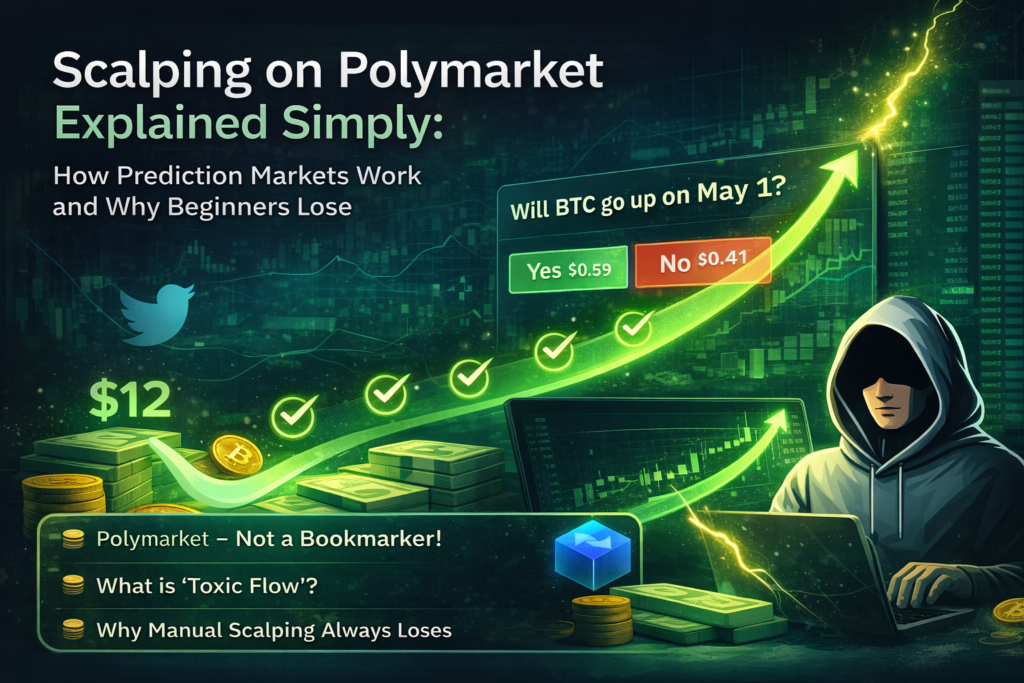
What Polymarket is — and why people confuse it with a bookmaker
Polymarket is a decentralized prediction market, not a traditional bookmaker. There are no “odds” in the usual sense. Instead, there is a probability market, where the asset price reflects the collective estimate of the likelihood of an event.
Each question has two tokens:
Yes — the event will happen
No — the event will not happen
Their total value always tends toward $1. This is the fundamental math behind prediction markets.
Both arbitrage and scalping on Polymarket are built on this principle.
How a prediction market looks from the inside
Polymarket operates not through an AMM, but through a CLOB (Central Limit Order Book) — a classic exchange order book. This means:
- there are bids and asks
- there is a spread
- you can place limit orders
- you can act as a maker or a taker
What scalping on Polymarket means in simple terms
Scalping is earning from the spread, not from predicting the outcome.
Analogy:
A currency exchanger buys dollars at 49 and sells at 51, without caring where the exchange rate goes tomorrow.
On Polymarket, it looks like this:
Buy Yes at 0.49
Sell Yes at 0.51
Profit = 2 cents per share
The lower the liquidity, the wider the spread.
A wider spread = more opportunity for scalpers.
Why manual scalping almost always fails
The key issue is speed.
A human reacts in 2–5 seconds.
Browsers show delayed data.
Transaction confirmation takes time.
Algorithmic traders:
- see price changes in 10–50 ms
- trade via API
- are physically closer to servers
- use private RPC nodes
Result:
A bot takes the opportunity before a human even notices it.
The main risk of scalping — toxic flow
Toxic flow happens when a fast, informed trader hits your order, already knowing news before you do.
Example:
You buy Yes at 0.10
News comes out that the event is impossible
Price drops to 0
You’re left holding a worthless token
That’s why scalping is a game of who’s faster, not who’s smarter.
Conclusion for beginners
- Beginners are better off focusing on medium-term events, not micro-movements
- Polymarket is a market, not a game
- Manual scalping is almost always negative EV
- Arbitrage and scalping win through infrastructure, not intuition
 Log in with Google


