How “whales” profit from Polymarket inefficiencies: arbitrage, bots, and market microstructure.
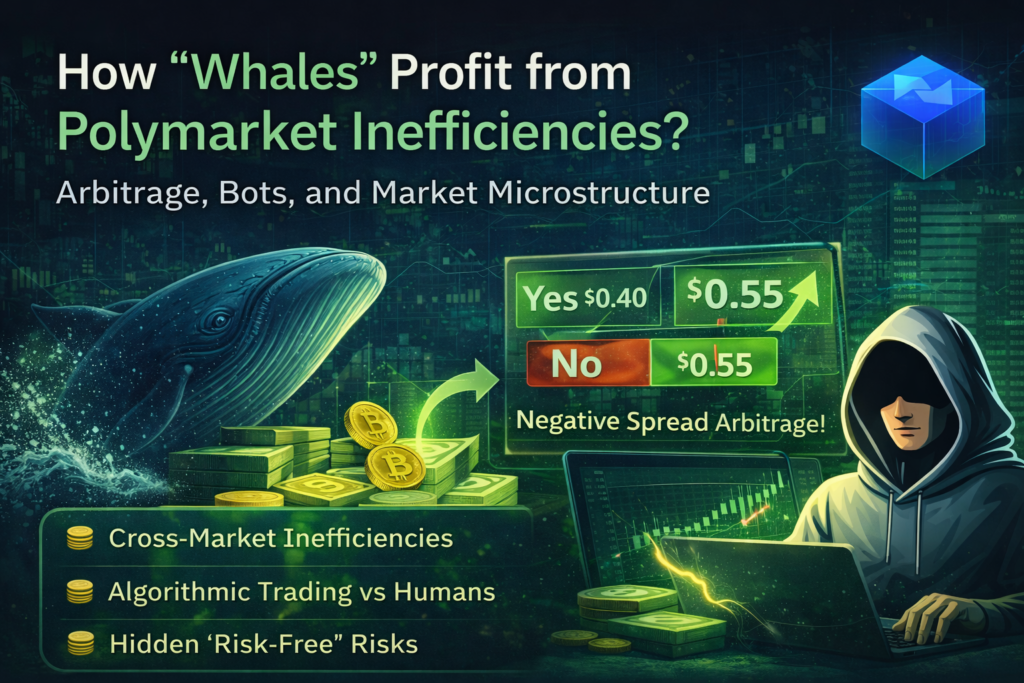
Arbitrage on Polymarket: what a negative spread is
In theory:
Yes price + No price = $1
In reality — not always.
Because of panic, delays, and human emotions, situations sometimes arise like:
Yes = $0.40
No = $0.55
Total = $0.95
This is called negative spread arbitrage or Dutch book arbitrage.
By buying both tokens, a trader:
- is guaranteed to receive $1
- locks in profit without making a prediction
Why these opportunities last only seconds
Reasons:
- asynchronous reaction of market makers
- panic market orders
- order book update delays
- human irrationality
Opportunity window: 100 ms – 2 seconds.
For a human — effectively zero.
For a bot — an eternity.
Why a “whale” made $250,000 — and why it wasn’t luck
The well-known case of trader Fish showed:
- profit ≈ $250,000
- strategy = arbitrage + scalping
- no predictions
- no emotions
The key wasn’t one trade, but:
- capital turnover
- thousands of micro-trades
- 0.3–0.5% per turnover
0.5% per hour × 10 times per day = completely different math.
Infrastructure: why a browser = disadvantage
An algorithmic trader uses:
- direct Polymarket API access
- WebSocket feeds
- private RPC nodes
- servers in the same data center as the exchange
- Builder Partner status
A manual trader deals with:
- Cloudflare layers
- request limits
- delays
- visual reaction speed
These are not equal conditions.
Hidden risks people don’t talk about
Even “risk-free” strategies have risks:
- oracle risk (UMA) — disputed outcomes
- blockchain reorg — one leg of arbitrage may fail
- code bugs — instant losses
- capital frozen for weeks
That’s why professionals treat this as a business, not a casino.
Conclusion
Polymarket is:
- a market transferring money from the slow to the fast
- from emotional traders to algorithmic ones
- from retail traders to infrastructure players
Understanding market microstructure is the first step toward not being liquidity for bots.
 Log in with Google


